Set Theory
Set theory is the branch of mathematics that studies collections of mathematical objects and the relationships among them. WIIS provides systematic learning materials on fundamental concepts of modern mathematics, with a particular focus on sets, functions, relations, cardinality, and order relations. While developing the language needed to describe mathematical objects rigorously, learners acquire a structural way of thinking through definitions, theorems, and proofs, building a foundation for real analysis, mathematical analysis, and university-level mathematics more broadly.
Fields of Set Theory

Set theory is the foundation of mathematics. Every mathematical concept can be described using sets. Here, we first define sets, then study set operations and their properties, and proceed to topics such as families of sets, Cartesian products, and relations.

An ordered set is a mathematical structure in which elements of a set can be compared with one another. Many areas of mathematics are built on the concept of order, ranging from the usual order relation on the natural numbers to inclusion relations between sets, the ordering of real numbers, and various structures that arise in linear algebra and topology.
New Materials
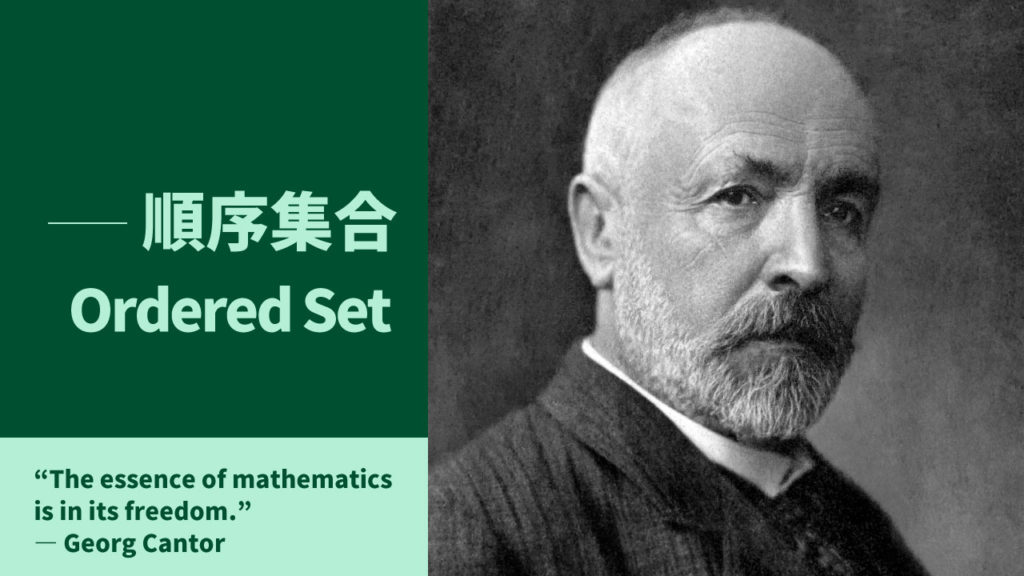
If every totally ordered subset of a partially ordered set has an upper bound, then the partially ordered set has a maximal element. This result is called Zorn's lemma.
For well-ordered sets, a proposition known as the principle of transfinite induction holds. This principle generalizes both the principle of mathematical induction and the principle of strong induction.
This section explains the well-ordering principle for the natural numbers. It covers least elements, well-ordered sets, the minimal counterexample method, and the relationship with mathematical induction, as well as applications to the Division Algorithm and the Euclidean algorithm.
Learning Guide
Related Fields

Logic provides the foundation for mathematical proof and reasoning. Through propositional logic and predicate logic, WIIS systematically explains logical formulas, truth values, quantifiers, and the basic ideas behind proof. These materials provide a starting point for studying university-level mathematics and other theoretical disciplines.
Latest Discussions
- Zorn’s Lemma 2件の返信 ・最終更新 6 days, 10 hours ago
- The Principle of Transfinite Induction 7件の返信 ・最終更新 6 days, 11 hours ago
- Well-Ordered Sets 3件の返信 ・最終更新 1 week ago
- Upper and Lower Bounds of Ordered Subsets 2件の返信 ・最終更新 1 week ago
- Maximal and Minimal Elements of Ordered Subsets 2件の返信 ・最終更新 1 week, 1 day ago
- Adjacency Matrices (Representing Order Relations by Matrices) 3件の返信 ・最終更新 1 week, 3 days ago
- Relationship Between Partial Orders and Strict Partial Orders 2件の返信 ・最終更新 1 week, 4 days ago
- Strict Partial Orders (Strictly Partially Ordered Sets) 4件の返信 ・最終更新 1 week, 5 days ago
- Partial Orders (Partially Ordered Sets) 3件の返信 ・最終更新 1 week, 5 days ago
- Complement of a Set 2件の返信 ・最終更新 1 month ago